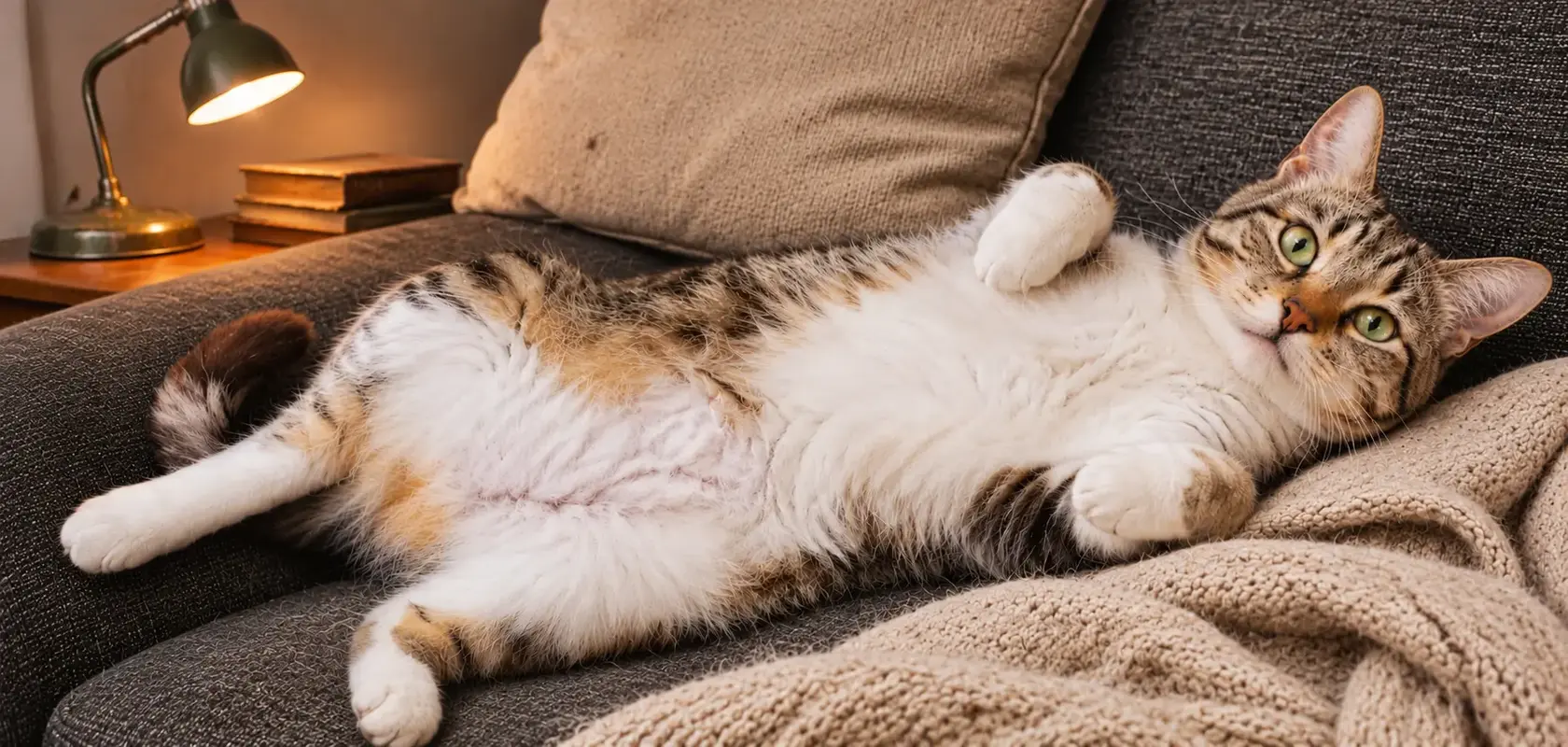
Cats who were born in the wild and have spent weeks, months or even years fending for themselves are often labelled as feral animals. Sadly, this has led many people to believe that it’s better to simply leave them alone, avoid interfering with “nature” or even regard them as unwanted pests.
But what if these so-called “feral” cats were given a chance? Could they adapt to living in a human home? Would they overcome their distrust of people and perhaps even become affectionate lap cats?
In our experience, the simple answer is yes. Given enough time, patience and care, that’s exactly what we’ve seen happen with almost all the cats we’ve taken in or helped find new homes.
From Wildcats to Domestic Cats
There is a widespread misconception that cats born on the streets are wild animals and therefore belong outdoors. But this argument ignores thousands of years of history and one fundamental fact: Domestic cats are not wild animals.
Our modern house cats (Felis catus) descended primarily from the African wildcat (Felis lybica). Their relationship with humans began around 10,000 years ago, when the first agricultural settlements emerged in the Near East.
Grain stores attracted rodents, rodents attracted wildcats, and humans soon recognised the advantages of having these skilled hunters nearby. Over countless generations, cats adapted to living alongside people.
Unlike dogs, they retained much of their ancestors’ appearance and behaviour, including their hunting instincts and territorial nature. Nevertheless, they became a domesticated species whose history has been closely intertwined with human civilisation ever since.
A kitten born in a drainage pipe, underneath a parked car or behind a restaurant is no more a wild animal than a kitten born in someone’s living room. Both belong to the same domesticated species. The circumstances of their birth do not change their evolutionary history.
And yet, street cats are frequently treated as though they were part of the natural wildlife. People argue that humans shouldn’t interfere, that cats are independent enough to look after themselves or that taking them indoors would somehow deprive them of their freedom.
The Ecological Impact of Free-Roaming Domestic Cats
The fact that domestic cats can survive without direct human care does not make them a natural part of the local ecosystem. Having spread across the world alongside humans, domestic cats are an introduced species in many regions. Their presence can affect native wildlife, particularly birds, small mammals and reptiles, through predation.
Unlike wild predators, free-roaming domestic cats often have access to food provided by humans. Their populations are therefore not necessarily limited by the availability of natural prey. Combined with their ability to reproduce several times a year, this can lead to large concentrations of cats around human settlements.
Street-cat populations are closely linked to human activity, including abandonment, uncontrolled breeding and access to food waste. Simply leaving these animals alone does not restore a natural ecological balance. Responsible intervention, including neutering and veterinary care, helps protect both the cats themselves and the wildlife around them.
How to Adopt a Street Cat
If a stray cat regularly visits your garden or neighbourhood, bringing it into your home doesn’t necessarily have to involve catching it and carrying it inside straight away. In many cases, a gradual approach is much less stressful for both the cat and its future caregivers.
First, make sure the cat doesn’t already belong to someone. A friendly cat wandering around outdoors isn’t automatically homeless. Ask neighbours, check local lost-pet groups and, when possible, have a veterinarian check for a microchip.
Once you’re reasonably certain that the cat needs a home, start by gaining its trust. Offer food at the same place and at consistent times every day. Depending on the cat’s temperament,
it may take days or weeks before it feels comfortable approaching you. Avoid chasing it, cornering it or forcing physical contact. Instead, allow it to decide how close it wants to come. If possible, gradually move the feeding location closer to your home.
This helps the cat become familiar with the building, your presence and the surrounding sounds. Once it appears comfortable, you can offer it the opportunity to explore indoors, initially without forcing it to stay. As soon as the cat can be safely placed in a secure carrier, arrange a veterinary appointment.
A thorough examination should include checking for parasites, discussing appropriate deworming and flea treatment, assessing vaccination needs and arranging neutering if necessary. The veterinarian can also advise on infectious disease testing and any additional care the cat may require.
After bringing the cat indoors permanently, provide a quiet, secure space with food, water, a litter tray and somewhere to hide. Keep the cat indoors during the initial settling-in period, giving it time to become familiar with its new surroundings.
Typical Behaviour of Street Cats During Their First Days Indoors
Even a street cat that has become comfortable around you outdoors may behave very differently once it enters your home. Familiar surroundings have suddenly been replaced by unfamiliar rooms, smells and noises. For an animal accustomed to moving freely between hiding places and escape routes, this can initially be overwhelming.
Hiding is one of the most common reactions. Some cats immediately retreat underneath a bed, behind a sofa or into the darkest corner they can find. They may remain there for hours or even days, emerging only when the house is quiet. Others spend considerable time observing their surroundings from a safe distance before daring to explore.
Changes in eating and sleeping habits are also common. A frightened cat may refuse food during its first hours indoors or wait until nighttime to approach its bowl. Some become unusually quiet, while others meow persistently, pace around the room or search for a way outside.
Scratching at doors and windows doesn’t necessarily mean the cat is incapable of adapting to indoor life. It may simply be responding to an unfamiliar situation. Defensive behaviour can also occur, even in cats that previously accepted petting outdoors.
Hissing, growling or swatting are usually attempts to create distance rather than signs of an inherently aggressive personality. A cat that feels cornered may react defensively because it cannot see an obvious escape route.
Not every former street cat responds this way. Some begin exploring almost immediately and settle down for a nap as though they have lived indoors their entire lives. Others need considerably longer to feel secure, and their behaviour may change from day to day as they become familiar with their new environment.
Do Adult Street Cats Need Litter Training?
In our experience, absolutely not. Of all the street cats we’ve taken into our home over the years, not a single one has needed to be taught how to use a litter box. Even cats that had spent their entire lives outdoors understood what to do as soon as they had access to one.
This is because burying urine and faeces is a natural behaviour in cats. In the wild, covering their waste can help reduce detectable scents, and domestic cats have retained this instinct. Outdoors, they typically look for loose soil, sand or similar materials that allow them to dig and cover their waste. A litter box simply provides an indoor alternative.
For the easiest transition, choose a sufficiently large, uncovered litter box and place it somewhere quiet and easily accessible, away from food and water bowls. Showing the cat where the box is located is usually all that’s necessary.
If a former street cat does eliminate outside the litter box, it shouldn’t automatically be interpreted as a lack of training. Stress, an unsuitable litter texture, a poorly positioned or dirty box, and medical problems can all contribute to inappropriate elimination.
Persistent problems should be discussed with a veterinarian rather than addressed through punishment.
Of course, individual experiences can differ. But based on the many former street cats we’ve welcomed into our home, using a litter box has consistently been one of the easiest parts of their transition to indoor life.
From Feral Cats to Affectionate Companions
One of the most remarkable experiences of taking in a former street cat is watching its relationship with humans change over time. An animal that once ran away at the slightest movement may eventually start following you from room to room, sleeping beside you or demanding attention whenever you sit down.
In our experience, former street cats can become extraordinarily affectionate, sometimes even more so than cats that have spent their entire lives in a comfortable home. Some develop an almost constant need for human company, insisting on being close to their caregivers and taking every opportunity to cuddle.
There is also something that feels remarkably like gratitude. Of course, we cannot know whether cats experience gratitude in the same way humans do. But when an animal that once struggled to survive outdoors begins seeking your company, greeting you enthusiastically and showing complete trust,
it is difficult not to feel that it appreciates the life it has been given. Perhaps this impression is so strong precisely because we know what these cats have experienced before. We have seen them frightened, hungry and exposed to the elements.
Watching the same animals relax into a warm bed, stretch out without a care in the world or fall asleep in someone’s arms makes their transformation all the more meaningful. This doesn’t mean every former street cat will become a lap cat.
Individual personalities still matter, and some remain independent or reserved. But being born outdoors, even with little previous human contact, does not prevent a cat from developing a deep and affectionate bond with people.